Wow. What a mess. Sort of like Apple's MobileMe, but not. My Phone will sync Windows Mobile settings, contacts, calendar data and photos, and provide a web interface for accessing and editing that data. It will even back up and restore the entire device via the cloud. And it's free.
But, unlike MobileMe, it doesn't push updates immediately when they're made and doesn't sync at all with desktop apps like Outlook, Vista Mail or Vista Calendar. It also has no integration with Live Hotmail, so users with a Microsoft email account won't be able to sync their contact data with My Phone.
"If you have Windows Live installed on your phone," the company's site notes, "it will synchronize your Windows Live contacts with the Windows Live web site, and My Phone will synchronize your other contacts to your account on the My Phone web site."
But not with each other?
Better yet, if you need to sync with Microsoft Exchange for work, then forget about My Phone, as you can only do one or the other.
So, uh, which sync should I use? Beats me. Get an iPhone. Or an Android gPhone. Or a Palm Pre. Even a RIM Blackberry.
Oh, if that wasn't enough, it appears that the service is not based on Microsoft's Live Mesh and Windows Azure, the cloud computing platform Microsoft is gearing up to provide to third party developers, or on Microsoft Exchange. So it's yet another Microsoft platform that doesn't interoperate with the others. Nice. Great way to get those developers on board.
If this doesn't encourage people to drop Windows Mobile for some other smartphone platform, I dunno what will. In typical Microsoft fashion, though, look for major improvements with the next major release in a year or six.
Monday, February 9, 2009
Microsoft plays catch up to MobileMe with My Phone


Thursday, October 30, 2008
AT&T gives free WiFi access to iPhone users

AT&T seems to have finally pushed the button—prematurely clicked a few times earlier this year—and granted iPhone subscribers the same free access to its national WiFi hotspot network that DSL, fiber, laptop 3G, and business subscribers already receive. The company posted a revised WiFi hotspot network page this morning, and reportedly texted some iPhone users with the new info.I've also heard that Boingo offers free WiFi service for iPhones, something that would be handy at many (most?) airports. Further, I've heard that you can access said Boingo service on your laptop by using Firefox with the useragent set to iPhone. I wonder if this trick would work at Starbucks....
Thursday, October 16, 2008
Reviews of the first Android-powered GPhone Roll Out
 HTC's G1, the first Android-powered smartphone, hits T-Mobile stores on Oct. 22. A few journalists have spent some time with the phone in advance of the launch and have begun sharing their early reviews. Much as you might expect, they are finding plenty to like and plenty to improve.
AP: Google's first phone smart, but needs work
PhoneScoop: HTC G1
UPDATED:
WSJ: Google Answers the iPhone
MSNBC: Android phone is a good iPhone alternative
Wednesday, October 1, 2008
AT&T: LTE 'Significantly Available' In 5 Years

Speaking at a technology conference, Hank Kafka, VP of Architecture for AT&T Mobility, said that AT&T has, "a lot of runway left with HSPA and HSPA-plus." He went on to imply that HSPA will continue to serve as AT&T's high-speed data network for at least another two or three years.
Kafka also mentioned that WiMax will remain a niche technology, and said that no company should be using the term "4G" (which is what Sprint is calling its Xohm network) until the standards bodies ratify the requirements of 4G networks. He expects LTE to be widely deployed within five years.
WiMax will remain a niche technology? Despite Sprint and ClearWire's major deployments happening now? Wow. Either that's a major insight or completely wishful thinking. Either way, I'm not sure it's a smart bet to think HSPA and HSPA-plus will cut it for "another two or three years." That's a helluva lead time they're spotting Sprint/ClearWire on introducing 4G to the market.
Wednesday, July 9, 2008
First iPhone 3G reviews trickle in

A few tech writers have had early hands-on time with the new iPhone and are releasing their initial reviews.
Monday, May 5, 2008
Hands on with Brightkite: real-world social networking
 This Ars Technica article does a pretty good job of explaining BrightKite and how to use it. Essentially, BrightKite lets you answer the question, "Where are you?" and shares that location with others. It will also show you who else is at, or has been at, that same location or nearby. It's very similar to Google's Dodgeball and Yahoo's Fire Eagle, both of which are also in limited release.
I've been using the service for a few days now and am impressed with the overall design and ease-of-use. For me, the primary limiting factor right now is the rather small number of my existing friends who use the service. However, I am experimenting with BrightKite's integration with Twitter, which has the potential to expose my BK check-ins to a wider circle.
Unfortunately, there aren't separate privacy controls for the feed to Twitter—Twitter sees the same as what you have set to public—so I'm working out just how exact I want my check-in locations to be. For example, "home" is currently just the part of town where I live, but retail locations are address-specific. After all, there's not much point in checking in at the coffee shop if no one can see more than just the city and state.
If BrightKite sounds appealing to you, Ars has a limited number of invites to the private beta. Jump in. All the cool kids are doing it!
Monday, April 7, 2008
Cell phoning from home pits WiFi against femtocells
 "What the eff is a femtocell?" you might be asking yourself. Short answer: another mystery box to add to your home network, but this one let's you make mobile phone calls over your broadband Internet connection.
"Why would I want to do that?" Two reasons: 1) unlimited free calls from home; 2) better coverage inside your house (or office).
"Couldn't I do the same thing with a WiFi-enabled mobile phone?" Why, yes, yes you could. If you can find one.
From the network's perspective, femtocells accomplish the same thing as an IP-enabled cell phone, in that they shift call traffic off the cell network and onto the user's broadband connection.Jump for a quick summary of the current situation.
Thursday, March 6, 2008
Twitter in Plain English
Then get off your sorry ass and start tweeting.
[via sleepydad]
Thursday, February 14, 2008
Starbucks Deal Brewed with AT&T Has Hints of Apple

AT&T and Apple clearly cut a deal where Starbucks benefits from becoming a digital media hub: It's going to be the place where people congregate to use Wi-Fi as part of the monthly service fee that they already pay AT&T - this wasn't announced yesterday, but it's absolutely coming - and where they download media from Apple....I was thinking the same thing. Apple and Starbucks are partners for free Wi-Fi access to the iTunes store for iPhones and iPod Touches. Apple and AT&T are partners for the iPhone. Not a big leap to see Apple as the common element linking AT&T and Starbucks.
It's not a leap at all that Starbucks, already a big music producer and seller, and one interested in revitalizing its business after a few years of drifting from its core coffee mission, would embrace the idea of being the place people who don't even like their coffee come to fill up on media, use the network, and hang out.
How nice of Glenn Fleishman to spell out all the details for me. In fact, he provides lots of additional details about the Apple-Starbucks relationship. This looks to be a much larger initiative than any of them are letting on. Get ready to spend a lot more time at Starbucks.
Sunday, February 10, 2008
Bluetooth to Piggyback on Wi-Fi
The popular wireless technology known as Bluetooth could get a lot faster next year by taking advantage of Wi-Fi technology already built into many gadgets.Devices won't be available until the middle of next year, but with ultra-wideband falling ever behind schedule, this looks like a great interim plan to boost transfer rates and hold down power consumption.
Linking Bluetooth and Wi-Fi may make it easier and faster to transfer large amounts of music between computers and cell phones, or send pictures from a camera phone to a printer, or video from a camcorder to a TV.
The combination devices will use the regular low-power Bluetooth radios to recognize each other and establish connections. If they need to transfer a large file, they will be able to turn on their Wi-Fi radios, then turn them off to save power after finishing the transfer
Sony Ericsson to make Windows Mobile phones
Sony Ericsson and Microsoft will cooperate in making smartphones, with the first Sony Ericsson handset based on the Windows Mobile operating system on sale by the end of the year.... The Microsoft deal means all the world's top handset makers apart from Nokia will now have Windows Mobile versions.What the hell is wrong with Sony these days? Are they completely devoid of leadership and risk-taking and even decent decision-making? Next they'll be adopting Palm OS or whatever it's called this month.
If they don't have faith in their own ability to execute a smartphone operating system, why go with Windows Mobile when they could choose market leader Symbian or mind-share leader Android? Choosing Windows Mobile seems all too ho-hum and also-ran. "Hey, we've got Windows Mobile just like everyone else." How are they going to differentiate their products based on that?
Today's Sony is so far from yesterday's Walkman.
Thursday, January 31, 2008
Will Only Outsiders Deliver Innovation in Mobile Phones?
When Apple introduced the iPhone, many of the established mobile phone makers publicly scoffed at Apple's ability to enter the mobile phone market, especially once they saw the pricing and the absence of a physical keyboard.
Palm CEO Ed Colligan "laughed off the idea that any company — including the wildly popular Apple Computer — could easily win customers in the finicky smart-phone sector. 'We’ve learned and struggled for a few years here figuring out how to make a decent phone,' he said. 'PC guys are not going to just figure this out. They’re not going to just walk in.'" Three months after launch, the iPhone had about triple Palm's market share in the US.
Microsoft CEO Steve Ballmer proclaimed, "There’s no chance that the iPhone is going to get any significant market share. No chance." Again, just three months after launch, iPhone was outselling all Windows Mobile phones combined. Of course, we've also seen a lot of established manufacturers introducing iPhone knock-offs in an attempt to compete with the iPhone's success. You might have noticed the LG Voyager, since it's almost always shown with an iPhone-like home screen.
Gruber sets us straight: "That's actually not the main UI of the phone. That's just the interface for accessing secondary features of the phone. The main UI is just like that of any other crap LG phone, and one of the 'apps' you can launch is the iPhone knock-off 'shortcut' mode. And, when you open the slider, the inside screen has a third different UI. The overall experience is worse, way worse, than that of a typical LG phone."
Google has a new open platform, Android, under development that may offer some innovative devices once they start shipping later this year. And Nokia's N95 receives rave reviews, except for it's ridiculous $695 pricepoint.
So who is going to offer a real competitor to the iPhone in this space? Sure as heck not Motorola. They've done such a fine job with the ROKR and the Q. How about Garmin? "What," you say, "the GPS maker?!" Well, sure. Why not. If a computer maker with a great UI can make an awesome phone, why not a handheld GPS maker with a great UI?  Meet the Garmin Nüvifone. Okay, they might need to work on the name, but this phone hits all the other bases square: attractive case design, 3.5" touchscreen, built-in still/video camera, SMS and MMS messaging, a whole host of Google apps (search, maps, mail, traffic, weather), and, of course, GPS-based navigation (duh). Plus it's Wi-Fi and 3G capable. Anyone besides me see a legitimate iPhone competitor here?
I sure hope Apple does.
Saturday, December 29, 2007
Could Tech Support Undo Palm?
 If you are thinking about getting a Palm device, this article and its comments ought to be enough to convince you to choose something else.
Tristan Louis was a loyal Palm customer/user until her recent encounter with Palm’s customer service. A snippet of her experience:
So I asked employee C11329 to be transfered to her manager. She told me she was the most senior person at Palm. I asked her again politely to transfer me to her manager. She told me she had none. I asked to be transfered to the person that was reviewing her work, giving her assignments, etc.. I was told she had none. I told her I felt that was odd as, apart from the chairman and CEO, I didn’t know of anyone in a company not having a manager. She told me she was the CEO.
For a second, I paused. “You’re the CEO of Palm, Inc.?” I asked again, not really believing what I was hearing. “Yes, I am” she replied, now with a defiant tone. “So you’re telling me you’re Ed Colligan?” I asked. “I am the CEO and that’s all you need to know.”
It goes on. Read it for yourself if you're looking for an amusing story of tech support gone wrong. Then follow Tristan's search for an alternative smartphone.
Absent some major, unforeseen development, I'd say it's clear Palm is done. The company has undergone an absurd number of iterations (or a number of absurd iterations?) and each one has weakened the platform to the point that it's become stagnant and irrelevant in the face of increasing competition and innovation.
Monday, December 24, 2007
RIM Up, Palm Down, As iPhone Kicks Ass
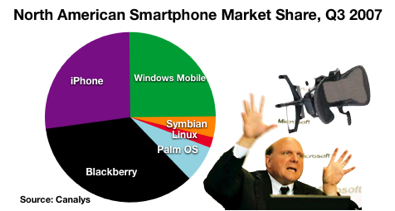 Palm and RIM have unusual fiscal calendars, so they've recently released results for their Sept. - Nov. quarters. Turns out Palm is continuing to tank and thinks cranking out more Windows phones will save them. Have any of them actually used a Windows-based phone? I guess it's a better experience than the actual Palm OS which hasn't received significant updates since Palm was, uh, relevant.
Meanwhile, RIM is on a tear, having discovered that ordinary consumers, and not just executives, might want smartphones, too. And here comes Apple, already grabbing larger market share in the US than Windows Mobile and closing in fast on BlackBerry.
Wednesday, November 28, 2007
Holiday Cell Phone Shopping Tips
"Now is the wrong time to buy a new cellphone."
Jackson Miller provides some astute analysis of the current and near-term mobile phone market, covering iPhone, Blackberry Curve, Nokia N95 and others.
Thursday, November 15, 2007
Papa John's takes texted pizza orders
I'm thinking, "Why would anyone want to order a pizza by text message? They're reaching on this one." And then they roll out the answer.
Nigel Travis, Papa John's president and chief executive officer, envisions hungry customers text messaging from malls or theaters so when they get home their pizza orders will be on the way.Ah, I get it now. Clever.
Thursday, November 8, 2007
Sprint to Prorate ETFs, Improve Customer Service
Maybe I'll be getting an iPhone a little sooner than anticipated....
Starting in 2008, Sprint will begin prorating early termination fees.For those not on Sprint: T-Mobile Will Prorate ETFs, Too
T-Mobile joins Verizon and AT&T, both of which introduced pro-rated ETFs earlier this year.
Thursday, October 25, 2007
Motorola: Apple won’t open the iPhone
A suit at Motorola
If we are to assume that the upcoming SDK next February won’t open up the iPhone completely, does that mean that Apple’s customers will be hurt? The iPhone is completely closed right now and its customers are far away the most satisfied in the industry, nearly three times more satisfied than Motorola’s. It’s hard to imagine when the iPhone gets third-party apps next year, customers will be less satisfied.
Monday, October 22, 2007
Free My Phone
[The current] mobile phone system... severely limits consumer choice, stifles innovation, crushes entrepreneurship, and has made the U.S. the laughingstock of the mobile-technology world, just as the cellphone is morphing into a powerful hand-held computer.Right on the money. Literally. (via Fake Steve)
Sunday, October 21, 2007
Strange Bedfellows: Why an Apple/Google collaboration has been so difficult to make happen.
You can see how easy it is, then, to gin up a strategy whereby each company plays to its strength. Google handles the back end and Apple the front end.... [However,] Apple isn't going to be satisfied making clever little interfaces to a world of information provided -- and owned -- by Google. Schmidt (and Carr) see that Apple doesn't have the supercomputer, but Jobs just as firmly believes that Google doesn't know how to run the supercomputer it has, and besides, he can rent a supercomputer anytime he wants one, so there.Hmm, didn't I say something to this effect back in September? Well, at least the first part (Carr's thesis) and, to some extent, the second (Cringley's). Cringely's analysis is spot-on (and much more colorful). (via Daring Fireball)